The Second City is comedy venue started in 1959 in Chicago. They now have branches in Toronto and LA. They have fostered the early careers of a lot of comedians (Bill Murray, the Belushi's, John Candy, Dan Aykroyd, Mike Myers...). Sourcebooks MediaFusion released a retrospective of all the great talent that came through SC. I haven't actually read the book, but it is accompanied by two Cd's that I absolutely love. They're filled with some of the best SC sketches. Here are a couple that tickled my mathematical funny bone.
(Warning: the comedy is a little rough. If you are sensitive or a younger reader, it is best to leave this post alone. There aren't any of the holy, holy swear words, but a few minor peccadilloes, and a lot of unpolitically correct humor. Remember, if you can't take a joke, don't.)
Ever feel like you belong to the null set? (Don't think too hard about that.)
And this is a doctors appointment on stats.
Thursday, April 9, 2009

Wednesday, April 8, 2009
Geek of the Week: Bertrand Russell

My youngest reader Lia sent me this quote from Bertrand Russell for the blog.
There is much pleasure to be gained from useless knowledge.It made me think of another great quote Jean-Marc introduced me to from Russell's autobiography. (BTW, Russell had a very unhappy youth.)
There was a footpath leading across fields to New Southgate, and I used to go there alone to watch the sunset and contemplate suicide. I did not, however, commit suicide, because I wished to know more mathematics.It suggests that all anyone seriously depressed needs is a little more math. I'm not sure geometry is ready to replace Prozac, but if it worked for Russell, it's worth a shot.
I googled Russell quotes because I forgot the exact wording on Jean-Marc's quote, and I found out that Russell was a master of the form. QuotationsPage had 63 entries for Russell. Here are some good ones.
Everything is vague to a degree you do not realize till you have tried to make it precise.This beautifully echoes the wonderful failure of his project Principia Mathematica.
If there were in the world today any large number of people who desired their own happiness more than they desired the unhappiness of others, we could have paradise in a few years.I have to believe he's exaggerating for effect, but let's hear it for a little enlightened self-interest! I could go on forever, but I'll end on this one about teaching.
Passive acceptance of the teacher's wisdom is easy to most boys and girls. It involves no effort of independent thought, and seems rational because the teacher knows more than his pupils; it is moreover the way to win the favour of the teacher unless he is a very exceptional man. Yet the habit of passive acceptance is a disastrous one in later life. It causes man to seek and to accept a leader, and to accept as a leader whoever is established in that position.
pic by Gisela Giardino
Tuesday, April 7, 2009
Prime Time

I was thinking about the possibility of defining a subset of the naturals containing numbers whose digits (appropriately grouped) are its own prime factorization. For example, take 32. It would be a number of this kind if 32 = (3)(2). (Of course it's not.) Are there any members of this set? Well, every prime number is trivially a member, 7 = 7, 11 = 11. The interesting question is, does this set have any composite members? I haven't been able to think of one yet.
I quickly checked the numbers less than 100 and there aren't any examples there. The only single digit numbers in this set are the primes. Consider the double digit numbers, 10 through 19. Let A be a digit, 0 through 9, if 1A = (1)(A), then 1A = A. Since no two digit number is equivalent to a one digit number, this isn't possible. (Note, 1A does not mean 1*A.) What about the numbers 20-29? If 2A = (2)(A), then the most (2)(A) could be is 14, because the most A could be is 7. But we know 2A is in the 20's so this is not possible. Any number in the 30's, 50's, and 70's will have the same problem. Any number 4A can only be grouped (4A) because 4 is not prime. So only the boring numbers (primes) in the 40's make it into the set. Same is true for the 60's, 80's, and 90's. What can we conclude? There is no composite example less than 100.
What about 3 digit numbers? We can start to make arguments by thinking of the grouping possibilities. If ABC is a three digit number, then we could group (A)(B)(C), (AB)(C), (A)(BC). Your mission: find a composite number in this set, or prove that there aren't any.
pic by kingfal
Monday, April 6, 2009
Math Contest

Friday was a big day for math at Tunxis. Both the Pi contest and CCC system-wide math contest were going down. It was a great day. The victor of the pi contest, Alex Bobman, memorized a whopping 302 digits! We are still waiting for the results of the math contest, but I'll post those as soon as I find out.
I was also able to get a copy of the math contest problems. I thought I'd pass along something fun.
A farmer had a daughter who spoke in riddles. One day the child was asked to count the number of goats and the number of ducks in the barnyard. She returned and said, "Twice the number of heads is 76 less than the number of of legs." How many goats were in the barnyard?
pic by ADoseofShipBoy
Friday, April 3, 2009
Math and Dance
I have a friend who is getting her doctorate in dance. I asked her if she knew of any intersection between math and dance. She dug up this link to Mathdance. There are a couple of professors that have written a series of instructional dance activities to teach math concepts. Pretty wild. I can't ever imagine leading my students in a ensemble dance of irrational numbers. Maybe I should. I went looking for inspiration on Youtube and found the Dance of Parallel Lines...
and some kind of wild trig dance...
and some kind of wild trig dance...
Thursday, April 2, 2009
Math, the Chaste Science

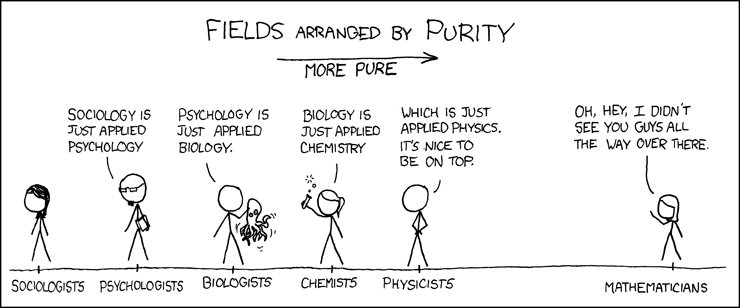
Check out this snarky math comic. Would anything outflank math on the right? Could there be a logician out there saying, mathematics is just applied logic?
Wednesday, April 1, 2009
Wine and Math

Who knew math would help you drink better? Enologix is a Napa Valley consultant using data analysis to help vineyards make better wine. I caught their profile in Wired. Not surprising in an industry dominated by connoisseurship, the analytic approach to production decisions has been quite controversial. I guess the only thing to do is open a bottle and find out. (You know the geeks are going to win, right. The geeks always win.)
pic by Buson
Subscribe to:
Posts (Atom)

 Posts
Posts