Showing posts with label question. Show all posts

Tuesday, July 7, 2009

Found Math

I found this on a notepad. And while it looks like math, I can't figure out how the numbers are related. Help!

**Reminder YofX will be moving to www.yofx.org in 13 days on 7/20**

Thursday, June 18, 2009

Tweaking Life

This is a thought on the game of life that Lee introduced me to a while back. John Conway has said that he played around with various rules to see which would produce the most interesting results. I took him to mean that he played around with the survival and birth rules. I was wondering if anyone has played around with tiles having different iteration speeds? Consider if every other column iterated at twice the speed. Basically squares could "play" at different speeds. Has anyone seen anything like this? Lee? Ken, I know you said you've played around with cellular automata?

Thursday, June 4, 2009

Topology Question


Ken's mention of Menger Sponges brought up the association with the Cantor set and the Sierpinski triangle. There must be a name for a topological property of objects from which a congruent copy/s of itself can be removed and the remaining portions of the object are equivalent to the removed piece. The interval, cube, and triangle are all such objects. It seems to me that there is now way that the circle is. Togologists help!

Tuesday, April 7, 2009

Prime Time


I was thinking about the possibility of defining a subset of the naturals containing numbers whose digits (appropriately grouped) are its own prime factorization. For example, take 32. It would be a number of this kind if 32 = (3)(2). (Of course it's not.) Are there any members of this set? Well, every prime number is trivially a member, 7 = 7, 11 = 11. The interesting question is, does this set have any composite members? I haven't been able to think of one yet.

I quickly checked the numbers less than 100 and there aren't any examples there. The only single digit numbers in this set are the primes. Consider the double digit numbers, 10 through 19. Let A be a digit, 0 through 9, if 1A = (1)(A), then 1A = A. Since no two digit number is equivalent to a one digit number, this isn't possible. (Note, 1A does not mean 1*A.) What about the numbers 20-29? If 2A = (2)(A), then the most (2)(A) could be is 14, because the most A could be is 7. But we know 2A is in the 20's so this is not possible. Any number in the 30's, 50's, and 70's will have the same problem. Any number 4A can only be grouped (4A) because 4 is not prime. So only the boring numbers (primes) in the 40's make it into the set. Same is true for the 60's, 80's, and 90's. What can we conclude? There is no composite example less than 100.

What about 3 digit numbers? We can start to make arguments by thinking of the grouping possibilities. If ABC is a three digit number, then we could group (A)(B)(C), (AB)(C), (A)(BC). Your mission: find a composite number in this set, or prove that there aren't any.

pic by kingfal

Thursday, April 2, 2009

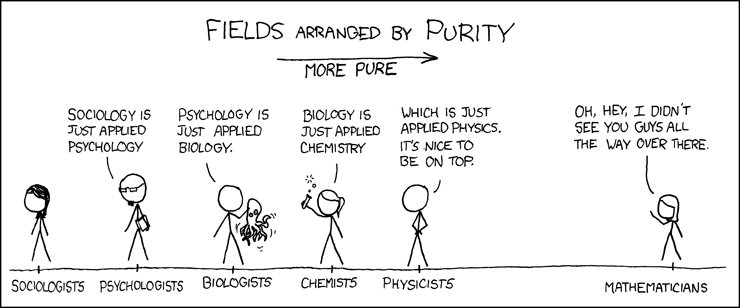
Math, the Chaste Science


Check out this snarky math comic. Would anything outflank math on the right? Could there be a logician out there saying, mathematics is just applied logic?

Tuesday, March 3, 2009

Question: Anyone seen these numbers before?

There is a long history of identifying subsets of the natural numbers particularly based on their divisibility properties. There are friendly numbers, extravagant numbers, deficient, perfect... The other day in class we were doing prime factorizations and I wound up with something like 2^2*3^3. I started thinking about all numbers n such that if n has a prime factor p, p^p divides n. Even more, I was thinking about adding the stipulation of sequential prime factors. So here are the first 4 numbers...
2^2=4
2^2*3^3=108
2^2*3^3*5^5=337,500
2^2*3^3*5^5*7^7=277,945,762,500
Anyone ever heard of numbers like this? What are they called? Are they used for anything?